
Today we're launching QuantaView, The Cryptographic Intelligence Platform, alongside the new EnQuanta website.
Before you change the cryptography in a live system, you need to know what depends on it and what could break.
That takes visibility into the algorithms, keys, certificates, and protocols your systems actually use. It also takes a way to assess a finding, approve a change, and check that the service still works afterward.
We built QuantaView to connect that work, from discovering cryptographic risk to making a change your team can approve and verify. That's what we mean by cryptographic intelligence.
Find. Fix. Defend.
Cryptography is everywhere. Visibility isn't.
Cryptography accumulated across the enterprise one application, library, device, and configuration at a time. Different teams own different pieces. Some of it is visible in a certificate console. Some is buried in a binary, inherited from a dependency, or negotiated between services.
Post-quantum migration makes that fragmentation an immediate planning problem. Before you can decide what to replace, you need to know what exists, what it protects, and what will be affected when it changes.
A scan can establish a starting point. But the environment keeps moving. Teams deploy applications, renew certificates, update libraries, and add services. The inventory has to keep up.
The inventory has to keep up
Federal guidance makes the connection explicit. OMB M-26-15 recommends automation where feasible and appropriate to keep cryptographic inventories current. It requires agency migration plans by October 22, 2026, and prioritizes high-value assets, high-impact systems, and other sensitive or vulnerable systems for post-quantum key establishment by the end of 2030 and digital signatures by the end of 2031. The memorandum excludes national security systems, which follow separate guidance.
Those requirements apply to federal agencies, but the operational challenge will be familiar to a security team at a bank, a utility, or any large enterprise. A migration plan needs evidence: what you have, what matters most, what has changed, and what still needs work.
The inventory becomes the working record of the migration. It helps teams set priorities before a change, check the result afterward, and track progress as the environment evolves.
From discovery to an approved change
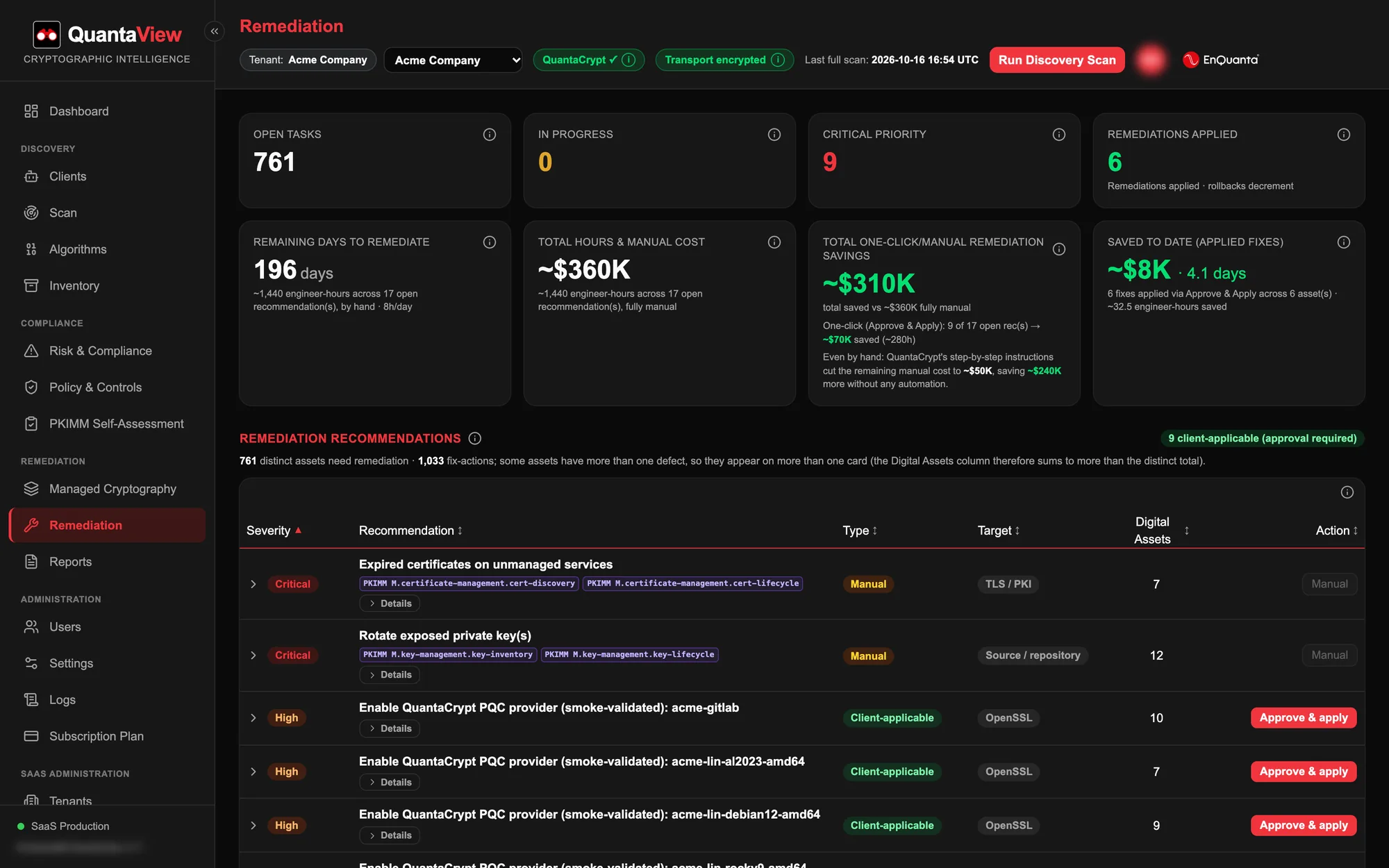
QuantaView combines findings from systems, networks, source code, and key-management tools into a living Cryptography Bill of Materials, or CBOM. That gives teams a shared record of the cryptographic assets they discover.
An on-device AI analyst helps assess those assets for quantum risk and against supported compliance frameworks. The model runs on your hardware, keeping that analysis within your environment.
For supported remediation workflows, an authorized person approves the change. QuantaView backs up the affected configuration, applies hybrid post-quantum key exchange through our QuantaCrypt core, and checks the service. If those checks fail, it automatically rolls back the change.
The person responsible for the system stays in control. Discovery leads to a finding they can evaluate, and an approved fix follows a process with checks and a recovery path.
Built on QuantaCrypt
We started with the cryptographic core before building the platform around it. QuantaCrypt provides the foundation for moving from a finding to a change in how a system is protected.
The EnQuanta QuantaCrypt software module is FIPS 140-3 validated under NIST CMVP certificate #5312. Post-quantum validation within the module boundary is still in process; it is separate from the existing validation.
That distinction matters when teams evaluate what they can deploy. So does the timing: as of today, September 22, 2026, only FIPS 140-3 validations remain on the CMVP active list. FIPS 140-2 validations have moved to historical status. NIST explains the transition here.
See QuantaView in action
The new website introduces QuantaView and the QuantaCrypt core behind it. The next step is to show the workflow on a real network.
On October 1, 2026, at noon Eastern / 11 a.m. Central, we'll run QuantaView live: discover cryptographic assets, review the findings, and demonstrate an approved remediation. Register to attend or receive the replay. We'll also discuss how to scope an evaluation on a representative part of your environment.
You need to know where your cryptography is. You also need a practical way to act on what you find. That's why we built QuantaView. Cryptographic intelligence you can trust.